
Book III - 50 - Slushing
Finally the use for the Vaseline
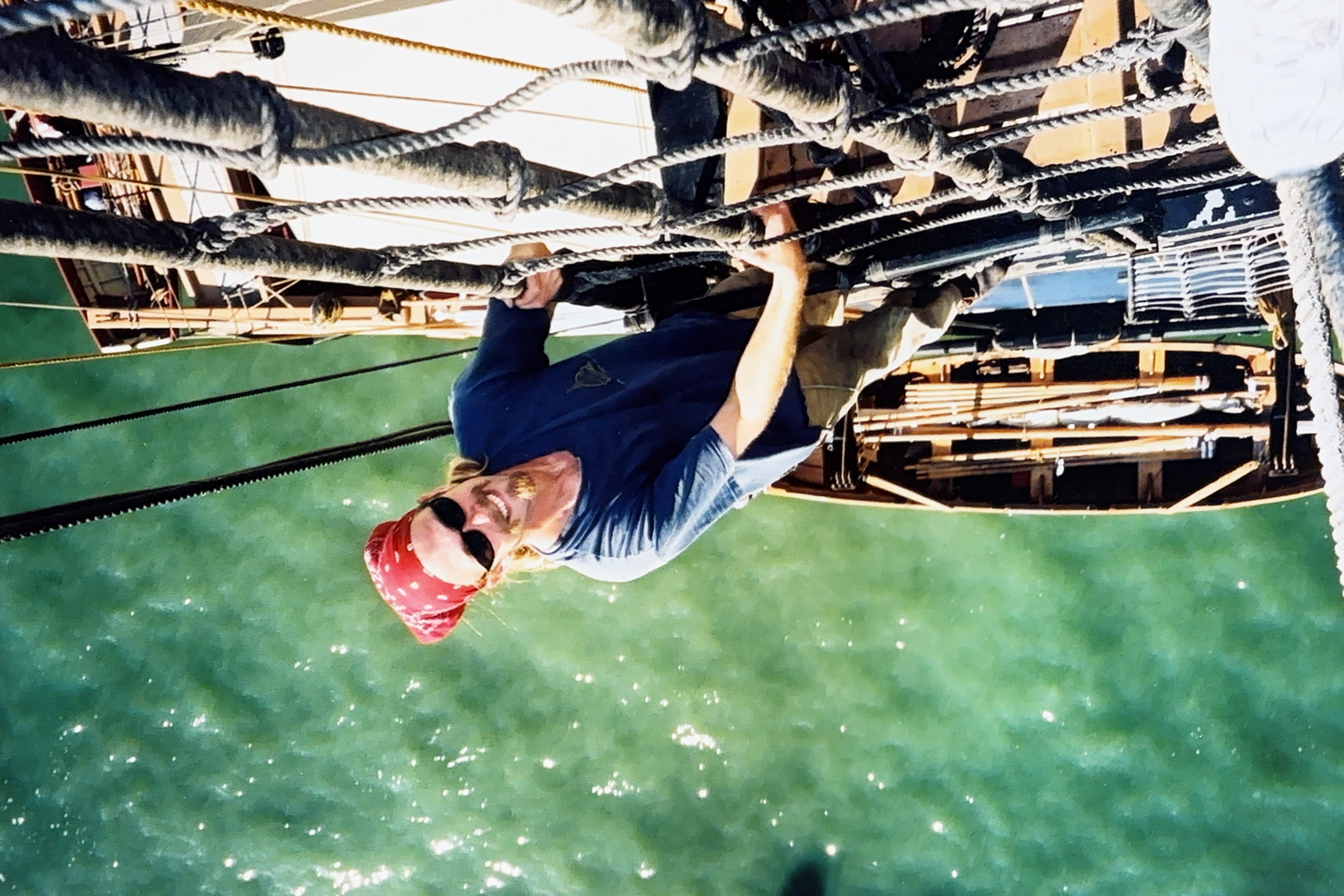
All this was merely prelude, however, and as we stood out into the lake these pleasant moments were gone from my mind. To our surprise and relief, Superior did not rise up and smash us like bugs, and the thunderstorms, though they prowled around the horizon, never came close. What we got instead was a gray, rainy, warm day with enough chop to make the ride interesting. Third division was on maintenance, and four of us were sent aloft to slush the topm’sts, while the rest of the division, working with David, was assigned the task of replacing the starboard main t’gallant brace.
Slushing was my first chance to use some of that tub of Vaseline we’d taken on at Erie, weeks ago. The tops’l and t’gallant yards, which we hauled up the masts every time we set the sails, were attached to the masts by a length of line. The lines, which ran from the mast around the yard and back, was hung with wooden beads that acted as rollers, and were called perils. The slush smoothed the movement of the perils on the masts. In the process, it picked up tar, dirt, and anything else that was up there, becoming a black, viscous goo. It also rubbed off, hence the re-application of the slush, and hence my being aloft.
The job was not the best one on the ship. Reaching the mast was easy at the fighting top, but getting at higher parts involved climbing up the inside of the shrouds and hanging there, holding on with one hand and smearing Vaseline with the other. This was made harder by the fact that it seemed impossible to keep from getting Vaseline on my hands, which made the climbing slippery. I also smeared it all over my foulies as the ship rolled and I bumped the mast. This, I found out, was bad in ways that were not nearly messy. “Try not to get that stuff all over your foulies,” Amelia said as I worked.
“Why not?”
“I think it does something to the waterproofing.”
“Oh, shit,” I said, regarding the dark smears on my jacket and bibs. I reflected that this information would have been more helpful half-an-hour ago, but, then again, I had been trying to avoid the slush anyway and had failed, so maybe it wouldn’t have made a difference.
I reflected that this information would have been more helpful half-an-hour ago, but, then again, I had been trying to avoid the slush anyway and had failed, so maybe it wouldn’t have made a difference.
From where I was up on the forem’st, I could see Andy and another volunteer on the mainm’st, slushing away as we were. Above them, David himself was up on the t’gallant crosstrees, watching as the new brace was led to the yard. The main braces ran from the deck up forem’st, then back to the main yards, where they were attached to blocks, themselves attached to pennants, out at the ends of the yards. I’d been wondering how one replaced a line underway, especially one that runs through a block way out at the end of the yard, but the solution was simple and, as it happened, rather nifty. The trick for replacing a line was to attach the new line to the end of the old one, and then pull the whole thing through, leaving the new line in place.
Now, David was watching as this was carried out, and a couple of other deckhands were aloft on the forem’st, making sure the line fed through. Unfortunately, they hit a snag. When the line was mostly pulled through, the old and new lines parted. Now the new line was run all the way from the deck to the foremast through the block on the t’gallant yard, but only went a few feet through and was just hanging there. As the lines parted, David uttered a “fuck!” that could be heard clearly on the foremast. The only thing to do now was actually to climb out on the yard and get the brace, and this David did.
This was an interesting idea indeed. The yards were generally held steady when people climbed on them, not only by the rolling tackles that kept them from swinging from side to side, but also by the braces themselves, which kept the yards from turning around the masts. With one brace off, the main t’gallant yard was turning quite a bit, swinging back on the starboard side, then forward until it fetched up on the port brace and stopped with a snap. I wouldn’t have even thought to get on a yard that was moving like that, but there David was, sliding out onto the yardarm, reaching for the brace. At one point, as the yard snapped to a stop in its forward swing and David was leaning out to grab the line, he almost went over the yard. I stopped slushing and just watched, along with the others on the forem’st, and hoped that our bosun wasn’t about to kill himself.
To my relief, he grabbed the line, fed it through, and then returned quickly to deck. The slushers from both masts got back down soon after. We stowed our slush and rags and gathered by the deckboxes. Andy was leaning over, hands on his knees.
“You alright?” I asked him.
“Argh, no. It was the motion, up on the masts. And working with all this gooey crap. I feel like hell.”
“You should drink some water. Dehydration and seasickness go together.” I got him a cup from the scuttlebutt. He accepted it gratefully. “Sometimes it helps if you look at the horizon,” I told him, not adding that it had never helped me very much.
Wade walked over. I stopped him, eager to talk about what I’d seen up aloft. “Did you see David up there leading that brace?”
“Yeah. That was fucking crazy shit.”
“Yeah it was. I thought he was going to die.”
“Me too. I’m glad he didn’t.”
“Sure, but why was he up there in the first place?” I said.
“To lead the line,” Wade replied.
“Okay, but I mean why did he climb out there on that yard?” Something about this was really bothering me, and I wasn’t quite sure why. “The way it was bouncing around, that shit was dangerous.”
“Of course it’s dangerous,” Wade said.
“Yeah, but that’s not my point. Why make it more dangerous? Why not take the time to try and stabilize the yard first somehow?
“What else could he have done? Besides, David’s hardcore, man. That’s the way he does things.”
I knew this was true, but there was still something nagging. “I just don’t think, when we’re doing a dangerous job, we ought to be making it more dangerous just because it’s hardcore, you know?”
“I guess,” Wade said, but I could see he didn’t really get my point. I wasn’t quite sure what my point was, anyway. Seeing David almost go over that yard had shaken me, and made me realize anew what was at stake every time we went aloft. Some of the professionals had a cavalier attitude toward working aloft that was at times awesome to watch, though at other times, like now, seemed foolhardy. I liked working aloft, liked the climbing, liked the focus, and liked doing something that I’d never believed I’d be able to do. But I was always afraid, if at times only a little bit.
Maybe this was it. The fact that some people didn’t seem to be afraid made me wonder why. My conclusion, of course, was that they were crazy. It was, perhaps, an easier conclusion to bear than the other, which was simply that they weren’t scared, and I was.
It was, perhaps, an easier conclusion to bear than the other, which was simply that they weren’t scared, and I was.
I definitely would be scared.
Nah, your instincts are right on!